
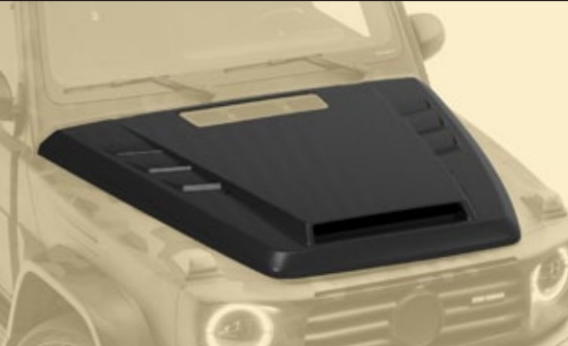
Engine bonnet I Mansory Carbon for Mercedes G-class G500 / AMG G63 W463A


Engine bonnet I Mansory Carbon for Mercedes G-class G500 / AMG G63 W463A
The Engine Bonnet I is the original carbon hood within the Mansory G-class W463A widebody programme — the first style ever offered, the one early adopters specced before bonnets II, III and IV existed on the menu. It sits as the most restrained of the four variants: OEM-shape replication, no large extraction vents, the smallest deviation from the factory stamping, and the thinnest layup of any Mansory bonnet for the W463A. Owners who started the conversion programme in the early years of the 4th-generation G specified this panel almost by default, and even today buyers who want carbon weight savings without the multi-vented later iterations choose Bonnet I. See the parent Mansory Carbon Body Kit for Mercedes G-class W463A G500/G63 for full programme context.
The Original Bonnet in the Mansory Programme
Bonnet I is the panel that started the carbon-hood line for the W463A. When Mansory opened the 4th-generation G programme, the brief was to replicate the OEM bonnet line in carbon — same bulge, same side reliefs, same shut-line geometry — and to take weight out without changing how the front of the car reads. That is what Bonnet I does. Later style variants (II, III, IV) introduced louvres and large extraction vents for owners who wanted a more aggressive upper plane, but Bonnet I remains the choice for a flush, factory-faithful look.
For owners who started their Mansory conversion in the early years of the programme, Bonnet I was specified almost by default — it was the only bonnet on the menu. Today it has a clear sub-segment of buyer: the owner who wants the carbon weight benefit and the texture, but does not want the bonnet to advertise itself across a car park. It is the quiet choice in a loud range.
OEM-Shape Replication & Panel-Gap Tolerance
The hardest part of producing a flush carbon bonnet for the W463A is not the stiffness — it is the panel gap. The factory steel bonnet sits in a roughly 4 mm shut-line to the front fenders, and the human eye reads gap drift across a 1.4-metre edge instantly. Mansory's tooling for Bonnet I targets a gap tolerance of +/- 0.5 mm along the length of the fender shut-line, achieved by laser-scanning a reference OEM W463A bonnet and back-fitting the mould to that scan. The leading-edge rubber seal sits in the same channel as the steel original, so water management at the cowl is unchanged — no new sealing strips, no pooling on the firewall.
Replication of OEM stamping radii matters as much as gap. The W463A bonnet is not a flat panel: it carries the central bulge, two side reliefs, and a small pressed step where the bonnet meets the cowl. RTM tooling captures all three features at the original radii, which is why the panel looks "right" against fenders that haven't been changed. A bonnet that exaggerates the bulge or softens the side reliefs will betray itself the moment you put it next to an unmodified steel fender.
Thin-Layup Reasoning & Stiffness Strategy
Because Bonnet I has no large openings cut into it, the panel behaves as a continuous shell — and shells are stiffer than panels of the same weight with apertures in them. That single fact is what allows Mansory to specify a thinner laminate here than on bonnets II/III/IV without the bonnet flexing on the road. Bending stiffness comes from the closed shape, a longitudinal UD spine and a sandwich-cored frame around the hinge and latch zones. The result is the lightest bonnet in the four-variant range and arguably the most efficient in stiffness-to-mass terms. In practical use, you do not feel the difference — the bonnet closes with the same firm thunk as the steel original — but on a corner-weight scale the front axle drops measurably.
The other consequence of the thin layup is repairability. A thin laminate is easier to feather-sand and re-laminate locally if a stone strikes the leading edge. Heavy multi-vented bonnets with thick laminates and structural louvres are far harder to invisibly repair.
- Weave: 3K twill 2x2 outer skin with UD reinforcement spine running fore-aft
- Cure: closed-mould RTM with heated tooling, post-cured to stabilise the matrix
- Shell wall thickness: ~1.6–1.9 mm at the visible panel (thinnest of the four bonnet variants)
- Inner reinforcement: laminated honeycomb-cored sandwich along hinge line and latch zone
- Finished weight: ~7.4–7.9 kg vs OEM steel ~14–15 kg
- Mounting: re-uses OEM hinges, latch and gas struts
- Finish: high-build clear lacquer over the weave, UV-stabilised, polished to factory gloss
Compatibility (W463A 2018+, G500/G63, Sunroof Variants)
Bonnet I fits the 4th-generation Mercedes-Benz G-class — Mercedes internal code W463A — from model year 2018 onwards. It is compatible across G500, G550, G400d, G350d and AMG G63 (M177 4.0 V8 BT). Both LHD and RHD cars are supported; the panel is symmetrical at the centre line. Sunroof variants are unaffected — the bonnet sits forward of the roof aperture, so panoramic-roof or pop-up-roof options do not change the fitment.
Pre-2018 W463 cars (the older "boxy" generation produced 1979–2018) are NOT compatible — different body, different mounting points, different cowl. W463A Gronos uses the GRONOS-specific bonnet and is also not interchangeable with this panel. W464/W465 next-generation G-classes are out of scope.
Installation, Hinge Re-Indexing & Strut Selection
Bonnet I bolts to the OEM hinges through factory thread inserts laminated into the inner skin, in the same positions as on the steel bonnet. Time on a properly equipped lift is around 90 minutes, including hinge re-indexing and gap setting. The weight reduction from steel to carbon means the OEM gas struts will hold the bonnet open at a slightly steeper angle — most installers leave the original struts in place if they're new, but on older cars with tired struts a stiffer aftermarket spec is recommended to avoid the bonnet drifting downward. Latch alignment is unchanged. The bonnet release cable, hood-up sensor and any insulation pad re-attach to OEM positions. Because the panel is RTM-cured and dimensionally stable, no shimming or block-sanding is required at the shut-lines on a correctly built car. This is a job for a Mansory-trained installer or a body shop with carbon-panel experience.
Pairing within the Mansory G-class W463A programme
The most common pairing is Engine Bonnet II — buyers who started with Bonnet I and later wanted the louvred look sometimes upgrade to II when freshening the car. The logo emblem badge for engine bonnet is the standard centre-line crest specified by virtually every Bonnet I buyer; it sits in the front quarter of the bulge and reads cleanly against the carbon weave. To complete the front-end visual, many specs add the fully carbon front mask with grill, which carries the same restraint philosophy as Bonnet I — full carbon, OEM grill geometry, no extra apertures. The three together form the "early-programme" front end. See the full kit at Mansory Carbon Body Kit for Mercedes G-class W463A G500/G63.
Surface Care, Repolishing & Stone-Chip Touch-Up
The lacquered weave is more delicate than a painted steel panel only in one direction: chips at the leading edge. The bonnet is a frontal panel and it will pick up stones. Walk around the car after every long highway run and check the leading 100 mm — that is where strikes land. Small chips that are still in the lacquer can be feather-polished and overlaid with a touch-up clear; chips that punch into the weave should be addressed by a body shop before water gets into the laminate.
For routine care, washing is conventional: pH-neutral shampoo, two-bucket method, microfibre, no abrasive sponges. Carnauba wax adds visual depth to the weave for a few weeks; a ceramic coating extends protection to 18–24 months. Avoid ammonia-based cleaners and dishwasher detergents — they will haze the lacquer. UV exposure is the other long-term enemy: park out of full sun where possible, or run a UV-stabilised top coat refresh every few years to keep the clear from yellowing.
Lead Time & Warranty
Lead time is typically 3–4 weeks from order to despatch, depending on lacquer queue. Bonnet I is in continuous production and does not require special tooling activation for stock spec; matte and tinted-lacquer variants add a week. The panel carries a 12-month manufacturer warranty against delamination, voids and dimensional defects. Warranty does not cover stone strikes, accident damage or improper installation — fit it through a competent body shop and document the install for the warranty file.
FAQ
Q: Why does Bonnet I have no big vents when the later bonnets do?
A: Bonnet I was the first style in the Mansory programme and was designed to replicate the OEM bonnet line in carbon, not to add cooling apertures. Bonnets II/III/IV were introduced later as more aggressive options for owners who wanted louvred or vented looks. Bonnet I remains the choice for a flush, OEM-faithful upper plane.
Q: Can it be retrofitted to an existing Mansory build that originally had no bonnet vents?
A: Yes — Bonnet I is a direct visual continuation of the original Mansory aesthetic, and it bolts to the same hinges and latch as the OEM steel item. If your car was specced without bonnet vents, Bonnet I drops in without any other changes.
Q: How much weight does it actually save?
A: Roughly 6–7 kg removed from the front of the front axle. That is meaningful — high, forward mass affects perceived steering feel and pitch under braking more than the same mass placed lower or further rearward.
Q: What is the panel-gap tolerance to the fenders?
A: Targeted at +/- 0.5 mm along the shut-line, with the OEM 4 mm nominal gap retained. The mould is back-fitted from a laser scan of a reference OEM bonnet, which is what allows the tolerance to be held across the 1.4-metre edge.
Q: Is it suitable for hot-climate use without vents?
A: Yes. The OEM W463A engine bay was designed without bonnet extraction; under-hood thermals are managed at the front air intake and the floor extractors. Bonnet I preserves that thermal logic. Owners running remapped power on track-style loads sometimes prefer II/III/IV for additional extraction, but for road and standard-load use Bonnet I is fully adequate.
Pair Bonnet I with the bonnet badge and the fully carbon front mask for the early-programme look, or bridge into the louvred era with Bonnet II. To configure or to ask about lacquer options, contact WhatsApp +44 7488 818 747 or [email protected].